A transportation program can meet every term in its contract and still fall short for the members it serves.
In 2026, more health plans and states began asking for evidence of non-emergency medical transportation (NEMT) performance instead of accepting it as reported. In our Q1 edition, we looked at how the Rural Health Transformation Program raised the bar for access, accountability, and measurable outcomes, and put transportation at the center of how states deploy rural funding. In Q2, we focused on network adequacy validation, now part of mandatory external quality review, and what it means for health plans asked to prove access rather than assert it. In Q3, we made the case that infrastructure is the answer to both the rural access gap and the program integrity gap.
This quarter sharpens the point. A transportation program can meet every term in its contract and still fall short for the members it serves. Service-level agreements (SLAs) measure whether a broker delivered what it promised. They do not always measure whether the network gets members to care.
As year-end approaches, health plans face a direct test: showing that their transportation benefit gets members to care. Verified, trip-level data is how they can show it.
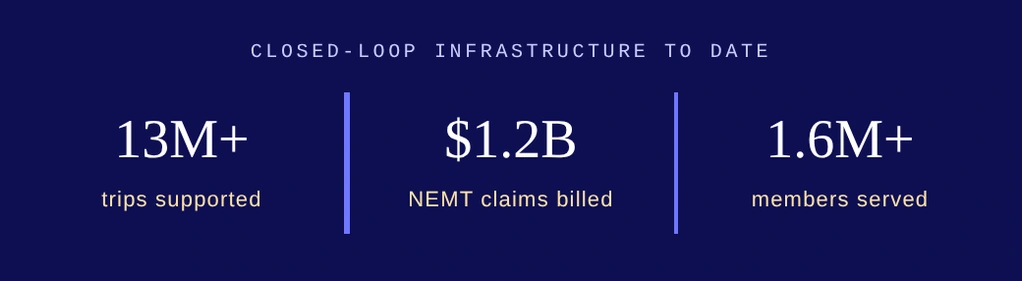
For Kinetik, 2026 was a year of building toward that answer. We rebranded in July as a tech-enabled services company that orchestrates the movement of people, data, and care. We launched the Kinetik Health App, earned HITRUST r2 certification, and delivered four seasonal product releases. Our closed-loop infrastructure has supported more than 13 million trips, $1.2 billion in NEMT claims billed, and more than 1.6 million members served.
Here’s what we’ve been thinking about…
In the media
Forbes Business Council — Contributions by Sufian Chowdhury, co-founder and chief executive officer
Becker’s Payer Issues — Contributions by Jill Hericks, head of strategic accounts
State spotlight: New Mexico
New Mexico has about 2.1 million residents spread across more than 121,000 square miles of land, roughly 17.5 people per square mile against a national average of 93.8. Distance shapes healthcare access across much of the state.
Medicaid is central to that access. As of July 2026, 818,515 New Mexicans were enrolled, 38.65% of the state’s population. Most are covered through Turquoise Care, the state’s fully integrated managed care program, in which four managed care organizations are responsible for all covered services, including transportation. The state holds those plans to a transportation standard: each must complete 90% of eligible general NEMT trips upon request, a target all four met in 2025. Network adequacy is measured in miles: 90% of members must be able to reach a provider within 30 miles in urban areas, 60 in rural areas, and 90 in frontier areas.
Maternal care shows what that distance means. About a third of New Mexico’s counties are considered obstetric deserts, with little to no access to obstetric providers, according to the University of New Mexico College of Population Health. A March of Dimes report found that women in the counties with the longest travel times drove an average of 97.1 miles to the nearest birthing hospital. Panelists at our July webinar described members who travel 100 to 150 miles round trip for a single appointment. If the ride does not come, the appointment does not happen.

The pressure on that system is about to increase. The Health Care Authority expects roughly 89,000 New Mexicans to lose coverage under federal work requirements, and more than 100,000 to cycle off coverage for at least two months under more frequent eligibility checks. At the same time, the state is receiving more than $211 million in fiscal 2026 Rural Health Transformation funding.
The state is also where Kinetik has seen what works under those conditions. A Medicaid managed care plan in New Mexico runs its own call center and member intake, while Kinetik manages the transportation provider network and billing inside one closed-loop record. More than 99% of claims are accepted on first submission, and every clean claim is paid within 30 days. In a rural market, prompt payment keeps small transportation providers in the network, and those providers are often the only option for members in outlying counties.
This year’s first two spotlights, North Carolina and Texas, showed the pressure building on programs that cannot verify their own data. New Mexico shows that a program can meet that standard under some of the hardest conditions in the country.
Read → Overcoming rural transportation barriers: Lessons from New Mexico
Policy watch
Eligibility changes arrive in January. Under Public Law 119-21, states must move most Medicaid expansion adults to six-month eligibility renewals for renewals scheduled on or after Jan. 1, 2027, and must have community engagement (work) requirements in place by the same date, as implemented through a CMS interim final rule issued in June. States that demonstrate a good-faith effort toward compliance can request a temporary exemption from CMS, which cannot extend beyond Dec. 31, 2028. More frequent renewals are expected to increase churn, which makes eligibility verification at the moment a trip is booked a core program integrity control. Sources: Public Law 119-21 (H.R. 1), Congress.gov | CMS-2454-IFC, Federal Register, June 3, 2026 | Tracking Federal Guidance on H.R. 1
Managed care access standards take effect in 2027. The 2024 Medicaid and CHIP Managed Care Access, Finance, and Quality final rule requires states to enforce maximum appointment wait times for primary care, OB/GYN, and outpatient behavioral health no later than the first rating period beginning on or after July 9, 2027, with annual secret shopper surveys to verify compliance starting in 2028. Wait time standards measure how quickly members can get an appointment, and transportation determines whether they arrive. Trip-level data can help plans show that access holds up beyond the scheduling step. Sources: Federal Register, Managed Care Access, Finance, and Quality final rule, May 10, 2024 | Public Consulting Group, Insights into the Managed Care Access, Finance, and Quality rule
Rural Health Transformation Program enters year two. The program’s first budget period closed Oct. 30, 2026, and the second began Oct. 31. On Nov. 9, CMS announced $10 billion in year-two awards to all 50 states, ranging from about $142 million to $282 million. CMS reviewed each state’s annual report before setting the awards, which it says reflect, in part, states’ progress implementing their approved plans. Sources: CMS, RHT Program reporting supporting statement | CMS, Year-two Rural Health Transformation awards, Nov. 9, 2026
Federal enforcement adds new tools. Following a July announcement, HHS Secretary Robert F. Kennedy Jr. formally delegated permissive exclusion authority to CMS in October, giving the agency that pays Medicaid claims the power to remove individuals and entities from federal health programs alongside HHS-OIG. Separately, CMS sent its proposed Comprehensive Regulations to Uncover Suspicious Healthcare (CRUSH) rule to the White House Office of Management and Budget on Aug. 7, and the federal regulatory agenda projects publication this fall. HHS-OIG has also opened a new series of audits testing whether selected states complied with Medicaid payment requirements for NEMT, including prior authorization and trip documentation. Sources: HHS, Statement of Delegation of Authority, Federal Register, Oct. 14, 2026 | Reginfo.gov, CRUSH (CMS-6098) | HHS-OIG, Audits of Medicaid Non-Emergency Medical Transportation Services
Texas: NEMT review pending as enforcement continues. The Governor’s Office directed the Texas Health and Human Services Commission (HHSC) to conduct a review of NEMT policy. As of this writing, its findings have not been publicly released. In July, the Texas HHS Office of Inspector General reported that a medical transportation company serving a Medicaid managed care organization generally maintained required records, but incorrectly reimbursed transportation providers for 31,149 of 379,920 trips in fiscal year 2023 and lacked required prior authorization for 38 of 58 trips tested. The company agreed to a $315,000 settlement. Source: Texas HHS OIG, Medical transportation company must repay Texas Medicaid
NEMT insights: from the blog
The gap between SLA performance and network quality in NEMT. A broker can meet every SLA while its network is built for provider count instead of reliability. This piece explains why that gap reaches members and what a right-sized network of partner transportation providers changes.
Why NEMT payment integrity starts before the claim. Federal regulators now treat NEMT as a high-risk Medicaid benefit, and retrospective audits cannot keep pace with its volume. This piece lays out four checkpoints that move proof to the moment of service, from eligibility at booking to mileage tied to the actual route.
The modular NEMT benefit. Most health plans either hand NEMT to a broker or run it entirely in-house, so changing one part of the program means changing all of it. In this white paper, Kinetik Chief Business Officer Mohammad S. Hossain lays out a third option: one data infrastructure that lets health plans choose who runs each function and change that choice as their program evolves.
Fall product update
This fall, we shipped updates across the Kinetik platform built around one goal: more control for the teams running programs and more independence for the members who rely on them.
Trip permissions by action: Grant trip permissions one action at a time, from creating and cancelling trips to bulk updates and escalation approvals, so each role has exactly the access it needs. Existing roles keep their current access until you change them.
Notice of Action and Pend letters: Generate letters for rides, GMR, and travel-related expenses directly from your trip list. Choose from 14 letter types or write a custom one. Member and trip details fill in automatically, and every letter is saved to the member’s record for audits, appeals, and grievances. Available for select health plans.
A larger pool for trip assignment: Trips are now matched against a larger pool of transportation providers, giving your team more options to fill every ride.
Automatic dispatch connection updates: When a transportation provider moves to a new dispatch platform, their connection updates automatically, so trips keep flowing without manual setup.
Early flags on claim outcomes: Claims whose adjudicated outcome differs from what was submitted are flagged early, so billing teams can follow up before small discrepancies turn into payment delays.
Accessibility for every member: The member app now aligns with the Americans with Disabilities Act and Web Content Accessibility Guidelines (WCAG) 2.2 AA.
Member edits to approved trips: Members can edit an approved trip in the app, and the change goes back to the health plan for re-review before it takes effect.
Faster, smoother performance: Pages load faster across the platform, and the member app runs more smoothly on older phones.
Learn more → Fall Product Updates | Request a Demo
In summary
In 2026, the expectations on Medicaid transportation caught up with what the benefit is meant to deliver. Rural funding raised expectations for access, regulators added new accountability requirements, and the gap between reported performance and how a program actually performs became harder to overlook.
The thread running through all four editions is the need to prove that a member reached care, that a trip happened as billed, and that a network delivers access in practice as well as on paper.
That expectation tightens in 2027. Eligibility changes begin in January, managed care access standards follow in July, and states’ rural health investments face their first progress reviews. Health plans will need to show their work at the trip level, the claim level, and the network level.
It’s also shaping what we build next. Kinetik expects to formally introduce new product lines focused on preventing fraud, waste, and abuse in early 2027, built on the same verified trip data health plans and state agencies already use to manage their programs. We will share more when they launch. Kinetik will keep building the infrastructure that makes trip-level proof possible, for every health plan that chooses to own, share, or delegate its program.